Team ARCADiA | Hauptwerk | 6.29 GB
这两种西班牙乐器在这个样本集是弗朗西斯·沙佩雷在蒙蓬-姆萨梅斯特萨梅罗收集的一部分。两个管风琴都被放置在礼堂里,礼堂是Chapelet在他家的花园里建造的。
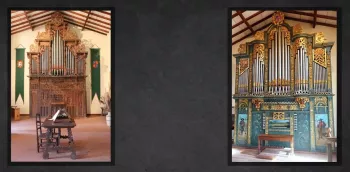
涂着绿色涂料的风琴来自加利西亚的Mondoñedo修道院。它是由一位匿名的风琴制造者在17世纪末建造的。1977年,Pierre chacimron修复了它。单个手册的所有站点都在中间c/c#之间划分。踏板永久连接到手动档的最低八度。该乐器有一个短的八度音程,在样品设置中是半音的。Hauptwerk软件能够模拟短八度,如果需要的话。
这个有着棕色外立面的乐器是由弗朗西斯·沙佩莱特从卡斯蒂利亚的一座毁坏的教堂中拯救出来的。查佩莱特买下了这架风琴,在它被搬出去一周后,教堂的拱顶坍塌了。那是一个空的风琴箱,只有前管和一个风箱被保留了下来。正面雕刻的日期是1736年。格哈德·格雷辛在1978年修复了这把乐器,并将其扩大,以容纳更多的曲目。这架风琴有两本手册和一个半音指南针,还有一个30个键的完整踏板。
在录音中发现的气质与韦克迈斯特三世相似。
由于这两种仪器共用一个房间,所以把它们放在一个样品集中似乎很有吸引力。通过这种方式,可以从单个控制台演奏二重奏,其中最低的两个操作手册可用于卡斯蒂利亚风琴,第三个键盘可用于加利西亚风琴。例如,可以将卡斯蒂利亚管风琴的音阶发送到位于左侧的扬声器,而将加利西亚管风琴的音频输出发送到位于右侧的扬声器(或以类似的方式使用前扬声器和后扬声器),以模拟礼堂对面墙壁上乐器的原始位置。踏板可以从一个踏板板操作,特别是因为加利西亚风琴没有专门的踏板停止。为了允许在风琴之间切换踏板板以进行双唱诗班表演,踏板耦合器被添加到加利西亚风琴上。当只演奏卡斯蒂利亚乐器时,加利西亚管风琴的踏板耦合器必须关闭,这样在踏板上就听不到加利西亚管风琴的停顿声。
特点:
样品以48kHz/24bit分辨率提供。多个版本有三个级别:短、中、长。支持Hauptwerk v4.2及更高版本,包括HW 5。样本集是纯波格式,没有加密。
混响时间
混响时间约为2秒。虽然风琴是用自然的声音录制的,但原来的房间太干燥了。这是一个好主意,增加一些数字混响的样本集。
键盘,pedalboard
卡斯蒂利亚风琴键盘的原始指南针是51个键(C-d3)。加利西亚风琴的原始罗盘是45个键(C-c3),低音八度短。指南针实际上是延伸的,以匹配样本集中的卡斯蒂利亚风琴的指南针。
卡斯蒂利亚风琴踏板部的原始指南针是27个键(C-f1)。加利西亚风琴的原始音阶是一个八度,永久地与手册相连。踏板可以通过附加的踏板耦合器从样品集的手册中分离出来。
Tremulants
Tremblant是使用Hauptwerk振动模型制作的。没有采样的颤音阶。
The two Spanish instruments presented in this sample set are part of the collection of Francis Chapelet at Montpon-Ménestérol. Both organs are placed in the Auditorium, which Chapelet built in the garden of his house.
The organ with the green paint comes from the former monastery of Mondoñedo in Galicia. It was built by an anonymous organ builder at the end of 17th century. It has been restored by Pierre Chéron in 1977. All the stops of the single manual are divided between middle c/c#. The pedal is permanently coupled to the lowest octave of the manual. The instrument has a short octave, which was made chromatic in the sample set. The Hauptwerk software is able to emulate the short octave, if desired.
The instrument with the brown facade was saved by Francis Chapelet from a ruinous church in Castilia. Chapelet bought the organ, and one week after it was moved out, the church’s vault collapsed. It was an empty organ case—only the front pipes were preserved and one of the windchests. The front carving bears the date 1736. Gerhard Grenzing restored the instrument in 1978 and enlarged it to allow for a wider repertoire. The organ has two manuals with a chromatic compass, and a full pedal of 30 keys.
The temperament found during the recording was similar to Werckmeister III.
Since both the instruments share the same room, it seemed appealing to put both together into one single sample set. In this way, it is possible to play a duet from a single console, where the lowest two manuals may serve for the Castilian organ, and a third keyboard can host the Galician organ. It is possible, for example, to send the Castilian organ ranks to the speakers positioned left, while sending the audio output of the Galician organ to the right positioned speakers (or using the front and rear speakers in similar manner), emulating the original placement of the instruments at the opposite walls of the auditorium. The pedal can be operated from a single pedal board, especially because the Galician organ has no dedicated pedal stops. To allow for switching the pedal board between organs for a double choir performance, a pedal coupler was added to the Galician organ. When it is desired to play the Castilian instrument only, the pedal coupler of the Galician organ must be off, so that no stops of the Galician organ are heard in the pedal.
Features:
The samples are offered in 48kHz/24bit resolution. The multiple releases have three levels: short, mid and long. Hauptwerk v4.2 and higher supported, including HW 5. The sample set is in plain wave format, no encryption.
Reverb time
The reverb time is ca. 2 seconds. Although the organs were recorded with its natural acoustics, the original room is excessively dry. It is a good idea to add some digital reverb to the sample set.
Keyboards, pedalboard
The original compass of the Castilian organ keyboards is 51 keys (C-d3). The original compass of the Galician organ is 45 keys (C-c3) with the short bass octave. The compass was virtually extended to match the compass of the Castilian organ in the sample set.
The original compass of the Castilian organ pedal division is 27 keys (C-f1). The original compas of the Galician organ is one octave, permanently coupled to the manual. The pedal can be detached from the manual in the sample set by means of an added pedal coupler.
Tremulants
The Tremblant is made using the Hauptwerk tremulant model. There are no sampled tremmed ranks.