Hauptwerk | 24.46 GB
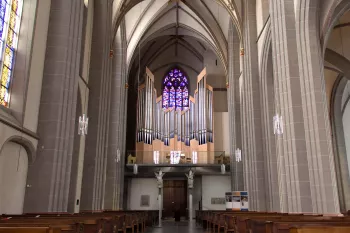
这套音色库取自德国北莱茵-威斯特法伦州戈赫(Goch)市的圣玛丽亚·玛格达莱纳教堂(St. Maria Magdalena)。该教堂内的管风琴由来自凯韦拉尔(Kevelaer)的 Romanus Seifert & Sohn 公司于2015年建造。在1993年尖塔倒塌之前,教堂一直使用的是一台1958年制造的Seifert管风琴,那台琴后来被埋在了倒塌的塔楼废墟之下。
如今戈赫教堂中的这台管风琴采用法式交响风格设计,拥有42个音栓(stops),完美地利用了哥特式教堂中悠长的混响效果。此外,从管风琴的外壳工艺可以看出,左右两侧的脚键盘塔楼仿照了教堂塔楼的风格,因此也可以视为对那次塔楼倒塌事件的纪念。
这台管风琴包含4个分部:Grand Orgue(I,主键盘)、Récit expressif(II,表达键盘, enclosed封闭式)、Solo(III,独奏键盘)和Pédale(脚键盘)。除Solo分部采用电传动外,其余分部均为机械传动。Grand Orgue分部拥有从16英尺到2英尺的完整主音栓列,音色饱满清晰,为添加簧管音栓提供了完美的基础。Récit分部非常 versatile(多功能),配有由谐波音栓组成的cornet decomposé(分解短号)、优美的弦乐音栓以及Voix Humaine 8′(人声8英尺)等独奏音色。Récit的每一个音栓都在开启tremulant(颤音器)的状态下进行采样,以获得最逼真的效果。Solo分部的设计理念与鲁昂圣旺修道院(Saint-Ouen Abbey)的Cavaillé-Coll管风琴相似。事实上,Grand Orgue自身只有一个簧管音栓,因此如果管风琴演奏者想要耦合合唱簧管(而不含GO中的 mixture混合音栓),就必须将第三手键盘耦合到第一手键盘。此外,Grand Orgue中缺失的谐波长笛也在Solo分部中得到了补充,还有一个非常有趣且罕见的音栓:Violoncelle 8′(大提琴8英尺)。脚键盘分部有两个32英尺的管音栓:Sousbasse和Violonbasse。后者的最低八度由16英尺和10 2/3英尺的音列共同演奏。由于空间限制,最低的音管位于管风琴箱体外,嵌入墙壁和地板中(水平放置)。借助Super II an P和Super III an P耦合器,脚键盘分部可以作为独奏声部使用,音色范围极为宽广。
采样库中新增了脚键盘分割功能(可从Simple Jamb页面访问)。它将脚键盘分为两个区域:较低的区域(C-H,即C2-B2)仅使用脚键盘音栓,忽略脚键盘耦合器;较高的区域(c-g1,即C3-G4)不演奏脚键盘音栓,仅使用耦合分部。
另一个新功能是音管延迟选项(Pipe delays)。它为音管(主要是簧管音栓)引入微小的延迟,以实现更逼真的效果。可在设置标签中禁用。
键盘的原始音域为C-g3(C2-G6)(采样库中扩展至c4即C7),脚键盘的原始音域为C-f1(C2-F4)(采样库中扩展至g1即G4)。
各分部音栓列表:
Grand Orgue(主键盘)
Montre 16′ · Montre 8′ · Salicional 8′ · Flûte à cheminée 8′ · Octave 4′ · Quinte 2 2/3′ · Doublette 2′ · Cornet IV · Mixture V · Clarinette 8′
耦合器:II an I · III an I · Sub II an I · Sub III an I
Récit-Expressif(表达键盘)
Bourdon 16′ · Diapason 8′ · Cor de Nuit 8′ · Viole de Gambe 8′ · Voix céleste 8′ · Prestant 4′ · Flûte octaviante 4′ · Viole d’Amour 4′ · Nasard harmonique 2 2/3′ · Octavin 2′ · Tierce harmonique 1 3/5′ · Plein Jeu IV · Cor d’Harmonie 16′ · Trompette harmonique 8′ · Basson-Hautbois 8′ · Voix humaine 8′
Tremblant fort(强颤音器)
耦合器:III an II · Sub II
Solo(独奏键盘)
Montre 8′ 1 · Flûte harmonique 8′ · Violoncelle 8′ · Flûte conique 4′ · Basson 16′ · Trompette 8′ · Clairon 4′
耦合器:Sub III · II an III
注:1号音栓借用自GO的Montre 16′
Pédale(脚键盘)
Violonbasse 32′ · Soubasse 32′ · Flûte 16′ 1 · Violonbasse 16′ 2 · Soubasse 16′ 3 · Basse ouvert 8′ · Bourdon 8′ · Octave 4′ · Bombarde 16′
耦合器:I an P · II an P · III an P · Super II an P · Super III an P
注:1号音栓借用自GO的Montre 16’;2号为Violonbasse 32’扩展;3号为Soubasse 32’扩展
试听视角
使用此音频播放器,您可以聆听采样库制作的不同音频声道。使用对应每个音频组的滑块来调节其音量。
技术细节
订购
选择您想要订购的版本。如果想先试听demo版本,请点击”Demo version”标签旁的”Add to cart”按钮,然后前往结账页面获取下载链接。Demo版本的唯一限制是可用音栓的数量。点击音栓列表下方的”Show demo version”按钮可查看可用音栓。
请注意,这些价格不含税。正确的增值税率将在您提供国家信息后在购物车内计算。
如需订购多个许可证,添加到购物车后可在购物车页面更改数量。
更新
目前尚未发布任何更新。
主页:
https://piotrgrabowski.pl/goch/
Situated in the St. Maria Magdalena church in Goch, a region in Nordrhein-Westfalen Germany, we find a new organ built by Romanus Seifert & Sohn from Kevelaer in 2015. Before the spire collapse in the year of 1993, a Seifert organ built in 1958 had been used until it was buried under the remains of the collapsed tower.
The instrument we find in Goch today is an organ conceived in the French symphonic style with 42 stops, which makes perfect use of the long reverb in its gothic church. Furthermore looking at the casework of the organ, one can see that the pedal towers to the left and right of the organ resemble the style of the church tower and therefore can be seen as a reminder of the tower collapse.
The organ consists of 4 divisions: Grand Orgue (I), Récit expressif (II, enclosed), Solo (III) and Pédale. All divisions have tracker action apart from the Solo, which is controlled by electric action. The Grand Orgue features a full principal chorus from 16′ to 2′. It has a full and clear sound, which makes a perfect foundation to add the reed stops. The Récit is very versatile with its cornet decomposé made of harmonic stops, beautiful strings and solo voices such as the Voix Humaine 8′. Each of the stops from Récit were sampled with the tremulant engaged to get the most realistic impression. As for the Solo division, it has been conceived in a rather similar manner as the Cavaillé-Coll organ in Saint-Ouen Abbey in Rouen. In fact the Grand Orgue has only one reed stop on its own, so if the organist wants to couple the chorus reeds (without the mixture which is found in the GO), it’s necessary to couple the 3rd manual to the 1st. Also the missing harmonic flute in the Grand Orgue is found in the Solo division as well as a rather interesting and rare stop: Violoncelle 8’. In the pedal division there are two 32′ flue stops: Sousbasse and Violonbasse. The latter’s lowest octave is made of 16′ and 10 2/3′ ranks playing together. Because of space issues the lowest pipes are outside the organ case and can be found built into the wall and into the flooring (placed horizontally). Thanks to Super II an P and Super III an P couplers, the pedal division can be used as a solo voice with a wide range of sounds.
In the sample set Pedal split function was added (accessible from Simple Jamb page). It divides the pedal keyboard into two zones: the lower one (C-H (C2-B2)) uses only pedal stops and ignores pedal couplers, the higher one (c-g1 (C3-G4)) doesn’t play pedal stops, but uses only coupled divisions.
Another new feature is Pipe delays option. It introduces small delays, mostly to reed pipes, to achieve more realistic effect. It can be disabled in the Settings tab.
The keyboards have an original range from C-g3 (C2-G6) (extended to c4 (C7) in the sample set) and the Pédale from C-f1 (C2-F4) (extended to g1 (G4) in the sample set).