Team ARCADiA | Hauptwerk | 13.73 GB
基德里奇风琴——德国“最古老的风琴”
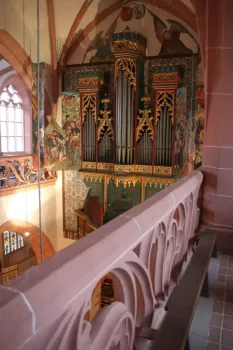
在基德里奇的圣瓦伦蒂诺和迪奥尼修斯教堂里,这种乐器被誉为德国最古老的可演奏风琴。虽然这可能不完全正确,但这个器官肯定是德国最古老的器官之一,它包含的元素可以追溯到1500年左右。
1652年,约翰·基什内尔(Johann Kirchner)重建了这架风琴,后来又修改了几次。在1710年修复风琴的合同中,第一次提到了6站的正音,尽管它可能已经被基什内尔添加了。独立踏板可能是在1722年添加的。19世纪所做的修复工作是引人注目的,因为它与当时对许多其他历史器官进行的修复是如此不同。当约翰·萨顿男爵(Baron John Sutton)在一次欧洲旅行中发现了这把乐器时,他被它的哥特式起源所吸引,并出资将它“修复”到1500年的状态(至少根据19世纪中期的浪漫主义观念和历史主义)。乐器部分由Louis Benoit Hooghuys修复,外壳(包括涂漆的侧翼)由August Martin de frth修复。
库恩的最后一次修复(1985-1987)保留了约翰·萨顿之前修复的状态,强调了风琴的哥特式Hauptwerk作为一个单一的手工风琴。
正音隐藏在教堂塔楼的主风琴箱后面,从而作为回声风琴发出声音,现代踏板也隐藏在教堂塔楼的风琴箱后面。
哥特式和新哥特式的元素在这座特殊的教堂里融合得非常好。当游客进入教堂时,他们真的被教堂的氛围所震惊。没有其他地方很常见的教会巴洛克风格,使得这座教堂和它的风琴绝对与众不同。
特点:
样品以48kHz/24bit分辨率提供。多个版本有三个级别:短、中、长。支持Hauptwerk v4.2及更高版本。样本集以纯波格式(未加密)提供。Hauptwerk高级版本必须运行完整的环绕声。支持Hauptwerk v.4.2及更高版本。
混响
混响时间约为3秒。
气质
原来的风琴调音是四分之一逗号。
键盘,pedalboard
原来的键盘指南针是45个键(C – c3),短的底部八度。踏板划分的原始罗盘是17个键(C – e0,低c#缺失)。
指南针在专门的ODF中扩展:手册49个键(满4个八度),踏板25个键(满两个八度)。
Tremulants
所有的队伍都记录下了最令人信服的震颤行为。然而,加载队列会消耗大量的RAM。可以选择使用人工震颤剂来节省RAM(开关位于混合器选项卡上)。
要求:
RAM消耗:6通道环绕
16位,其他设置默认为10.5 GB
20bit,其他设置默认:16.9 GB(推荐)
24位,其他设置默认:19.1 GB
屏幕分辨率1280×1024 px或更高。
3000个声音的复调建议为完整的环绕。
环绕格式
样本集提供环绕变型(6通道)。除了通常的4通道环绕外,还有两个可供选择的前通道。总共有4个前置音频通道和2个后置通道。两对前排有两种不同的录音位置:直接(靠近管道)和扩散(远离乐器)。这两对前排既可以自由地混合在一起,以达到两个极端之间的任何收听位置,也可以单独使用——这取决于用户的偏好。在Hauptwerk有一个专用的“混音台”,可以将声音混音到所需的水平。
Kiedrich – the “oldest organ” of Germany
The instrument in the St. Valentinus and Dionysius church in Kiedrich has the reputation of being the oldest playable organ in Germany. Although that may not be exactly correct, the organ is certainly one of the oldest in Germany, and it contains elements stemming from around 1500.
The organ was rebuilt by Johann Kirchner in 1652 and later altered several times. In the contract to repair the organ in 1710, the Positif of 6 stops is mentioned for the first time, although it was presumably added already by Kirchner. The independent pedal was added probably in 1722. The restoration done in the 19th century is remarkable, because it is so unlike those performed on many other historical organs at that time. When the Baron John Sutton discovered this instrument on one of his journeys through Europe, he was captivated by its Gothic origin and he supplied the money to “restore” the instrument to its 1500 state (at least according to the romantic perceptions and the historism of the mid 19th century). The instrumental part was restored by by Louis Benoit Hooghuys, and the case (including the painted side wings) was restored by August Martin de Fürth.
The last restoration by Kuhn (1985-1987) preserved the state achieved by the previous restoration of John Sutton, emphasizing the Gothic Hauptwerk of the organ as a single manual organ.
The positiv is hidden behind the main organ case in the church tower, thus sounding as an echo-organ, and the modern pedal is also concealed in the church tower behind the organ case.
The Gothic and the neo-Gothic elements blend together exceptionally well in this particular church. The visitor is truly astonished by the church’s ambiance when entering the building. The absence of the ecclesiastical baroque, which is so common elsewhere, make this church and its organ absolutely extraordinary.
Features:
The samples are offered in 48kHz/24bit resolution. The multiple releases have three levels: short, mid and long. Hauptwerk v4.2 and higher supported. The sample set is offered in plain wave format (unencrypted). Hauptwerk Advanced version is necessary to run the full surround. Hauptwerk v.4.2 and higher supported.
Reverb
The reverb time is ca. 3 seconds.
Temperament
The original organ tuning is quarter comma meantone.
Keyboards, pedalboard
The original compass of the keyboards is 45 keys (C – c3), short bottom octaves. The original compass of the pedal division is 17 keys (C – e0, low C# missing).
The compass is extended in a dedicated ODF: manuals 49 keys (full 4 octaves), pedal 25 keys (full two octaves).
Tremulants
All ranks were recorded with and without tremulants for the most convincing tremulant behavior. However, loading tremmed ranks consumes large amount of RAM. It is possible to select to use the artificial tremulant instead to save RAM (the switch is located on the mixer tab).
Requirements:
RAM consumption: 6-channel surround
16-bit, other settings default: 10.5 GB
20-bit, other settings default: 16.9 GB (recommended)
24-bit, other settings default: 19.1 GB
Screen resolution 1280×1024 px or more.
Polyphony of 3000 voices recommended for the full suround.
Surround format
The sample set is offered in the Surround variant (6 channels). In addition to the usual 4-channel surround, there are two more alternative front channels. In total, there are 4 front audio channels and 2 rear channels. The two pairs of the front ranks feature two different recording positions: direct (near to the pipes) and diffuse (distant from the instrument). These two pairs of the front ranks can either be mixed together freely to achieve any listening position between the two extremes, or used separately – depending on the prefererences of the user. A dedicated “mixing desk” is available in Hauptwerk to mix the sound to the desired level.