File size: 47.1 MB
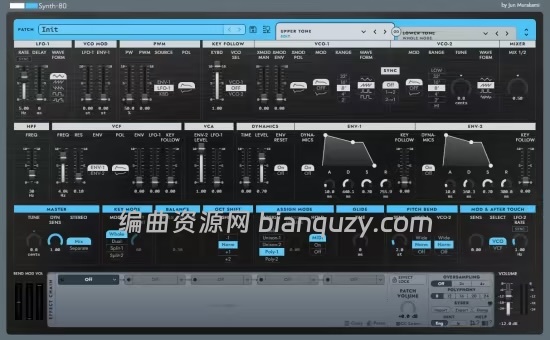
Synth‑80,Jun Murakami(高桥淳)开发,高度硬件实测复刻 Roland MKS‑80 Super Jupiter(Rev.4)8 复音模拟机架合成器,开发者编写超过 100 套自动测量程序,对原版硬件每一条电路、参数做详尽采集建模,细致还原滤波器、芯片噪声振荡器等模拟细节,大量音色与原版硬件几乎难以分辨。原版 MKS‑80 一大特点是几乎全部参数支持 MIDI 控制,非常适合软件仿真研究。
核心功能
‑ 单页全景 UI:全部参数集中一屏,无需翻页;鼠标悬浮高亮对应模块,直观看清信号流向,降低音色设计门槛。 ‑ 五插槽高品质效果机架:4 套完全不同合唱模型(Synth / Studio / Pitch / Digital),Hall、Plate、Room 多算法混响、ZeroComp 压缩器;效果链可独立导出为单独插件 Synth‑80 FX,给其他轨道使用。 ‑ 硬件编辑器 & 音色库管理:MIDI 对接真实 MKS‑80 硬件,支持 SysEx 批量音色转储、音色库构建;可双向同步插件与硬件音色。 ‑ 出厂预置 530 + 音色,附带多位第三方声音设计师扩展音色库。 ‑ 注意:深度电路建模 CPU 开销较高,建议实际 DAW 内试用 demo 评估性能。
插件格式
Standalone 独立程序、VST3、AAX;macOS 额外支持 AU;不支持 VST2 与 32 位。
系统要求
Windows:Windows10 及以上 64‑bit,4GB 内存,4 核 3GHz CPU,100MB 磁盘空间;Windows 不支持 ARM 处理器 macOS:macOS11+,4GB 内存,4 核 3GHz / Apple M1,原生支持 Intel 与 Apple Silicon。
The world’s only, and finest, JUPITER that faithfully recreates the legendary MKS-80. The Roland MKS-80 SUPER JUPITER is a legendary synthesizer produced only for a short period beginning in 1984. Often overshadowed by popular keyboards such as the JUPITER-8, this 8-voice polyphonic analog synthesizer is defined not only by its refined sound but also by a remarkable trait: almost every one of its parameters can be controlled over MIDI.
For a fully analog synthesizer of its era this was extraordinarily rare, and it makes the MKS-80 an ideal subject for software-synthesizer research — in other words, it is easy to build measurement programs that retrigger notes again and again while automatically sweeping the parameters, capturing detailed analyses. For this project I wrote more than 100 dedicated automated measurement programs covering every circuit and parameter of the MKS-80.
This long-term, detailed analysis of the MKS-80 (Rev.4) was carried out in parallel with the software programming itself, and I pushed the audio DSP tuning to the very limit, relying on the ears I have cultivated over many years as a composer and music producer. As a result, when you load exactly the same patch on both and play them side by side, for many patches it is virtually impossible to tell which is the software and which is the hardware.
From the delicate characteristics of the filters to the noise oscillators with subtle nuances derived from IC chips, the sound texture, recreated with meticulous attention to every detail, elevates the level of hardware emulation to a new height.
System Requirements
Windows 10 or later (64-bit)
4 GB RAM
4-core CPU, 3 GHz
100 MB free disk space
ARM processors are not supported on Windows