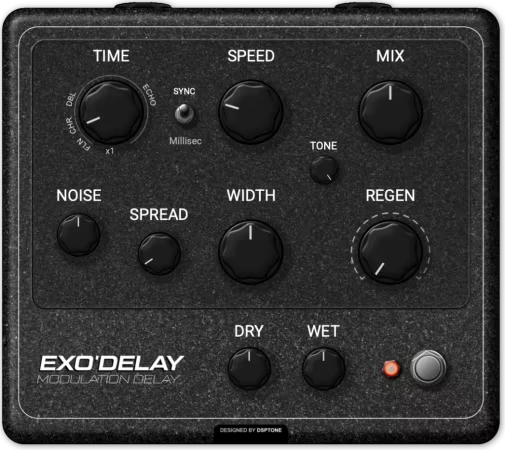
File size: 18.7 MB
- 复古数字延迟质感
- 带动态闪避功能的调制回声
- 经典音域范围 + 现代三重延迟模式
清晰的重复回声 / 稳定的延迟时间 / 丰富的调制效果
数字延迟在今日依然重要
- 较短的延迟范围助力节奏型演奏
- 较窄的带宽更易融入混音
- 细腻的调制效果增添动态感而不杂乱
- 饱和与底噪效果营造层次感与临场感
延迟模式
- DMOD:带宽偏暗,音色特质鲜明,适用于节奏回声与经典调制质感
- DMOD-10:音色顺滑,清晰度均衡,适用于旋律延迟与渐变调制
- DMOD-20:带宽明亮,重复回声干净,适用于空间感延迟与细节丰富的调制
- MODERN TRI:三重延迟串联为一条渐变延迟线,适用于氛围音效与复杂节奏设计
灵活可变的时间范围(匠心设计)
路由架构
底噪、立体声扩展、调制深度与反馈(匠心设计)
额外控制功能
- AUTOGAIN(自动增益):调节饱和阶段的输出电平,使其与输入电平匹配
- DUCK AMT(闪避量):控制效果信号的电平衰减程度,闪避效果的持续时间由延迟时间(TIME)旋钮控制
- DUCK SHAPE(闪避曲线):控制闪避响应的平滑度或锐利度
乐器处理适用场景
- 吉他(GUITAR):节奏延迟、调制主奏、纯净氛围质感
- 贝斯(BASS):带闪避功能的短延迟、增添宽度的细腻调制
- 合成器(SYNTHS):动态回声、立体声移动、音效设计层叠
- 人声(VOCALS):节奏同步延迟、提升清晰度的闪避功能、偏暗的音色设置
- 鼓组与打击乐(DRUMS & PERC):快速回弹回声、立体声节奏延迟、可控反馈质感
From vintage digital echoes to modern evolving modulation motion. Several delay eras combined into one, from tight vintage echoes to modern textures. Characterful modulation delay inspired by early digital delay designs of the 1980s and reimagined for modern production.
– Vintage digital delay character.
– Modulated echoes with dynamic ducking.
– Classic ranges + modern triple delay mode
Unlike BBD, early digital units offer
Clear repeats / Stable delay time / Modulation
However, memory was expensive and bandwidth was limited. Each generation of digital delay had its own distinct character — defined by delay time limits, filtering, noise floor, and modulation behavior. Some units focused on short, chorus-like delays. Others expanded delay time at the cost of bandwidth. Later designs pushed clarity and range further.
Digital Delay Still Matter Today
We inspired in this effect by Ibanez™ pedals (DML, DML10 & DML20) from 1980th. As well-known part of the early digital delay era *
ExoDelay captures this evolution by offering multiple delay characters, each reflecting a different design philosophy from that era — and then extends them with modern routing and control.
Shorter delay ranges encourage rhythmic playing.
Narrower bandwidth sits better in a mix.
Subtle modulation adds movement without chaos. Saturation and noise create depth and presence
DELAY MODES
Inspired by guitar fx delay pedals
• DMOD: darker bandwidth & stronger character. Rhythmic echoes and classic modulation textures.
• DMOD-10: smoother tone & balanced clarity. Melodic delays and evolving modulation
• DMOD-20: brighter bandwidth & cleaner repeats. Spacious delays and detailed modulation
• MODERN TRI: x3 Delays into one evolving delay line. Ambient effects, rhythmic complexity design
Variable time range as masterpiece
Extended automatically depending on mode
Each Delay mode includes own time range. You can create effects like flanger, chorus, vibrato, doubling, snapback and echo delay lines. Sync – switching Time parameter between Milliseconds and Beats, Triplets & Dotted time-synced values.
ROUTING ARCHITECTURE
Same principles as other delays, but with added feature of modulation (LFO changes the delay time)
-> Input stage -> Pre-Emphasis stage -> Saturation stage -> Delay stage -> De-Emphasis stage -> Ducking stage -> Tone stage -> Dry & Wet Mix -> Output stage
Noise, Spread, Width & Regen time range as masterpiece
We build it with noise injection of vintage chips with saturated and bandwidth limited character. Emphasis & De-emphasis stages is also part of the device architecture. Noise adds perceived motion, improve depth illusion, makes feedback feel alive. Spread adjusts the stereo width, adds flanger effect. Regen set the amount of delayed signal fed back into the delay stage
ADDITIONAL CONTROL
AUTOGAIN: Adjusts the output level of the saturation stage to match the input level.
DUCK AMT: Amount of level reduction on the effect signal. Duration of the ducking effect controlling by the delay TIME knob.
DUCK SHAPE: Controls how smooth or sharp the ducking response is
USE FOR INSTRUMENTS PROCESSING
– GUITAR: Rhythmic delays. Modulated leads. Clean ambient textures
– BASS: Short delays with ducking. Subtle modulation for width
– SYNTHS: Animated echoes. Stereo movement. Sound design layers
– VOCALS: Tempo-synced delays. Ducking for clarity. Darker Tone settings
– DRUMS & PERC: Slapback echoes. Stereo rhythmic delays. Controlled feedback textures