File size: 29.3 MB
SonicWorld Telsie S 是一款三段均衡器插件,其设计基于 20 世纪 70 年代著名的西门子(Siemens)W295b 分立甲类(discrete class A)均衡器。
W295b 以其美妙通透的高音和浑厚饱满的低音而闻名。Telsie S 完美复刻了这一标志性音色,并相比其模拟原型提供了极具实用价值的升级!
该硬件最初由西门子为德国公共广播联盟(ARD)设计,体现了当时的最高技术水准,处于行业技术前沿。这些调音台是电子管 V72/V76 调音台的直接继承者,其中采用了如 V276 话放和 W295 系列均衡器等备受追捧的模块。
西门子共推出了三个版本的均衡器:W295、W295a 和 W295b,其中 W295b 的设计最为精巧。所有型号均配备低搁架滤波器和高搁架滤波器,但唯有 W295b 额外拥有带临场感(Presence)/切除功能的中频带。直至今日,W295b 依然是众多工程师的“秘密武器”,因为它能带来那种令人惊艳的空气感和通透高频。
作为 SonicWorld,我们对这款模拟杰作非常熟悉,在过去的 20 年里,我们一直在维护和安装此类设备。
现在,无需再忍受旧开关的咔嗒声、老化的电容和难寻的晶体管,你就能获得纯正的经典之声。
Siemens W295b 与 Telsie S 的核心特性
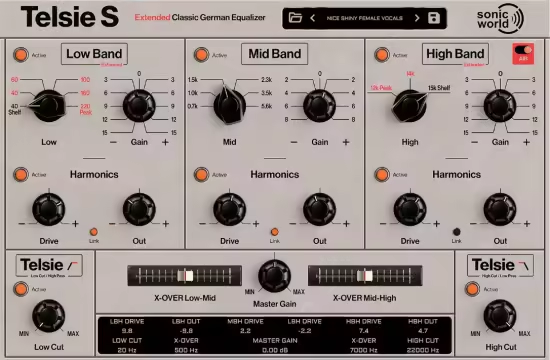
与原版硬件一致,Telsie S 是一款三段均衡器,高低频为搁架滤波,中频为峰值滤波。
- 低频搁架:±15 dB 调节点位于 40 Hz。
- 高频搁架:±15 dB 调节点位于 15 kHz。
- 中频:具备临场感/切除功能的峰值滤波器,提供 6 个可选中心频率(0.7 kHz、1 kHz、1.5 kHz、2.3 kHz、3.5 kHz 和 5.6 kHz),最大增益和衰减均为 8 dB。该峰值滤波器具有比例 Q 值特性,即增益或衰减量越大,频段越窄。
Telsie S 插件的额外优势
1. 具备更多频率选项的低频滤波器
作为对原硬件 40 Hz 搁架滤波的补充,插件增加了峰值滤波选项,中心频率分别为 40, 60, 100, 160 和 220 Hz。这些峰值滤波同样具备比例 Q 值特性,提供了远超原版 40 Hz 搁架的音色塑造可能。
2. 具备更多频率选项和 AIR 开关的高频滤波器
高频段保留了原版令人赞叹的 15 kHz 搁架滤波,并新增两个峰值滤波选项,中心频率为 12 kHz 和 14 kHz,调节步进为 3 dB,最大调节量为 ±15 dB。AIR 开关显著扩展了高频的频响,你甚至可以通过提高工程的采样率来让这一效果更加明显。
3. 谐波(Harmonics)功能
三个均衡频段均配备了谐波功能,包含 Drive(驱动)和 Out(输出)两个参数。Drive 用于调节注入信号的谐波量以丰富音色;Out 用于补偿驱动带来的音量提升。默认情况下两者联动,可通过 Link 开关解除联动。
注意:解除联动后可能出现极端的增益或衰减,请注意保护听力及硬件设备,开发者不对此类潜在损害负责。
4. 低切/高通与高切/低通滤波器
低切(高通)和高切(低滤)滤波器用于清理信号的频段。例如去除原声吉他或人声的低频轰鸣,或切除刺耳的高频。两者均提供-12 dB/Oct 的平缓斜率,截止频率可自由调节。
5. 低/中频及中/高频的分频点(X-Over)控制
模拟 W295b 的高低频曲线非常宽广,这意味着在 40 Hz 处的提升甚至会影响到 2 kHz,反之亦然,这种特性常导致不必要的频段染色。
Telsie S 引入了两个分频点(X-Over)控制,允许你设定三个均衡频段的结合位置。出厂默认值为 500 Hz 和 7 kHz。
这一功能对于精细调整均衡曲线、适应不同 EQ 需求非常有用。例如,你可以在 220Hz 提升低频给人声打底,同时通过将分频点调至 400 Hz,精准切断 400 Hz 以上的多余频率,从而让音色更加干净、指向性更强。高频段同理。
6. 总增益与参数条(Parameter Bar)
总增益(Master Gain)用于补偿因均衡或谐波处理带来的电平变化,双击总增益旋钮可重置为 0 dB。
参数条直观显示三个频段的谐波量(LBH, MBH, HBH)、高低频截止点、两个分频点的选择频率以及总增益的数值。
更新内容
- 更新:官网未提供此版本的变更日志。
The SonicWorld Telsie S is a 3-band equalizer plug-in based on the famous Siemens W295b discrete class A equalizer from the 1970s.
The W295b is known for its wonderfully airy highs and voluminous bass. Telsie S delivers this sound, along with some very useful upgrades compared to its analog counterpart!
Designed and built for the ARD (Association of German Public Broadcasters) in the 70´s, the Siemens mixing consoles reflected what was technically feasible at the time and were at the cutting edge of technology.
These mixing consoles were the direct successor for the tube-based V72/V76 mixing consoles.
Highly sought-after modules like the V276 Microphone Preamp and the W295 Series Equalizer were used in these consoles.
Siemens offered 3 different Equalizer versions: The W295, the W295a and the W295b which has the most elaborated design of the 3 models.
All these models share a low-shelf filter and high-shelf filter, while only the W295b features a mid-band with a presence/absence filter.
The W295b is still today the secret weapon of many engineers as it provides these VERY nice airy highs ….
At SonicWorld we know this analog marvel very well, as we have been servicing and racking many of these units in the last 20 years.
Interior of vintage Siemens W 295B Equalizer showing electronic components and control knobs.
Now you can have that sound without the crackle of old switches, dried-out capacitors, hard-to find transistors, etc.
The features of the Siemens W295b and Telsie S
Similar to the original hardware device, the Telsie S is a three-band equalizer with shelf-filters on the high and low bands and a peak filter on the mid band. The low-shelf filter has its ±15 dB point at 40 Hz, while the high-shelf filter has its ±15 dB point at 15 kHz.
The mid-band is a presence/absence filter with Peak characteristics and 6 selectable center frequencies
0.7 kHz, 1 kHz, 1.5 kHz, 2.3 kHz, 3.5 kHz, and 5.6 kHz, and a maximum boost and cut of 8 dB each.
This peak filter has a proportional Q factor. This means that the width of the bell narrows the more dB you boost or cut.
The additional benefits of the Telsie S plug-in
Low Band Filter with additional frequencies
As an alternative to the original device’s low-shelf filter at 40 Hz, there are additional peak filter frequencies with center
frequencies at 40, 60, 100, 160 and 220 Hz.
These peak filters have a proportional Q factor, meaning the width of the bell narrows the more dB you boost or cut.
These additional peak filter frequencies give you significantly more sonic possibilities than the original shelf filter at 40 Hz.
High Band Filter with additional frequencies and AIR switch
The high band features the original device’s super nice- sounding high-shelf filter at 15 kHz. As an alternative Telsie S also offers two additional peak filters with center frequencies at 12 kHz and 14 kHz, with a maximum boost or cut of 15 dB in 3 dB steps.
The AIR switch significantly extends the high band’s frequency response. You can experiment with running your session at a higher sample rate to make this effect even more noticeable
Harmonics function
Each of the three equalizer bands has a harmonics function with two parameters: Drive and Out.
The Drive control allows you to adjust the amount of harmonics added to enrich the signal.
You can use the Out control to compensate for the increase in volume caused by the Drive section.
The two parameters are linked by default. You can disable this by using the Link switch.
Be careful when you do this as extreme boosts or cuts are possible.
Extreme boosts could not only harm your ears, but also your equipment.
We do not take responsibility for any potentional damage.
Low Cut/ High Pass and High Cut/Low Pass Filter
The Low Cut (High Pass) and the High Cut (Low Pass) filters are used to clean up the frequency range of your signal .
For example low rumble on an acoustic guitar or vocal track can be easily reduced with the Low Cut, or you can cut the high-frequency range for nasty frequencies.
Or with using both filters to give room for other tracks.
The cutoff frequency is freely selectable, both filters have a gentle slope of -12 dB per octave.
X-OverS Low Band/Mid Band and Mid Band/High Band
On the analog W295b, the high and low band curves are extremely broad. This means that a boost or cut in the 40 Hz shelf band has a sonic impact up to approximately 2 kHz. With the 15 kHz shelf band, a boost or cut has a sonic impact starting at around 200 Hz.
This characteristic never sounded appealing to us, as it often results in unwanted processed frequency ranges, even if you only want to boost or cut at much higher or lower frequencies.
This is where the two X-Over frequency controls come into play.
These allow you to set the respective frequency at which the Telsie S’s three equalizer bands merge.
The factory default crossover frequencies for the two crossover frequency controls are 500 Hz and 7 kHz.
This lets you give the presence band more space, even if you don’t want to boost or cut anything in this frequency range.
A close-up of a vintage control slider labeled “X-OVER Low-Mid” with a white knob and red indicator line, set at the middle position.
A linear alphanumeric control panel with a white slider and a red vertical line and the text ‘X-OVER Mid-High’ below.
This is very helpful for significantly influencing the equalizer curves and finding the right sound for different EQ requirements. You can boost for example with the low band a good amount at 220Hz or lower to give vocals a good basis and you can cut off unwanted higher frequencies at 400 Hz if you lower the X-over from 500 Hz down to 400 Hz.
The same goes for the high band. You can massively boost the high frequencies and avoid boosting unwanted frequencies at 7k if you set the X-Over Mid-High to a higher value than 7 kHz.
Try our EQ presets to find out how useful this feature is!
Master Gain and Parameter Bar
The Master Gain is used to compensate for level differences caused by equalization or harmonics.
Clicking the Master Gain control resets it to 0 dB.
The Parameter Bar displays the set values of the three harmonics bands LBH (Low Band Harmonics), MBH (Mid Band Harmonics), HBH (High Band Harmonics), the Low- and High-Cut filters, the chosen frequencies of the two X-overs and the Master Gain.
Whats New
Updates: official site does not provide any info about changes in this version